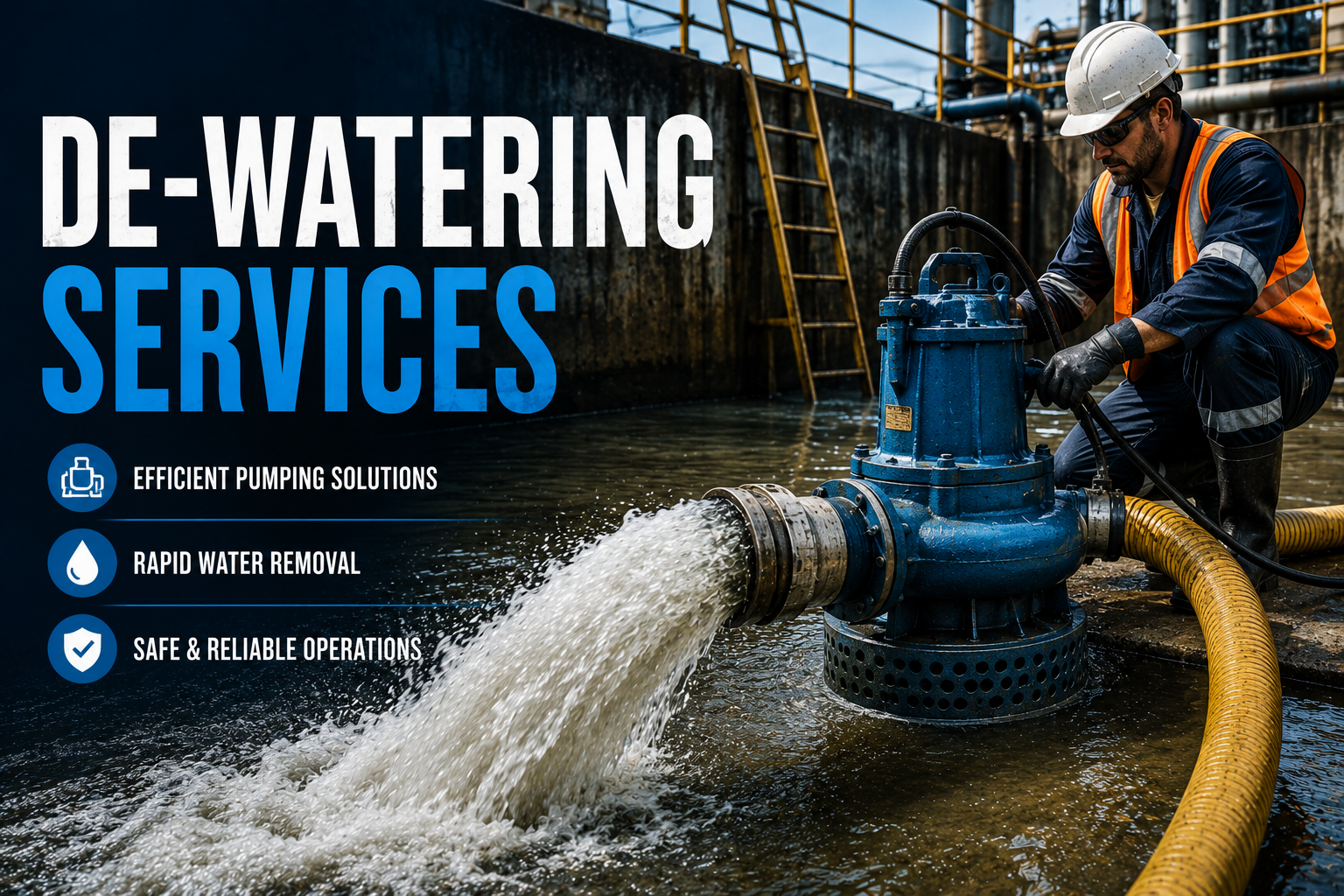
De-watering services are essential processes employed in construction, mining, and various other industries to remove excess water or liquids from a particular area, typically from construction sites, excavation pits, or industrial facilities. The primary goal is to create a dry environment for safe and efficient work, ensuring the integrity of structures and equipment. In this article, we will explore the importance, methods, and benefits of de-watering services.
Importance of De-Watering:
De-watering plays a critical role in various industrial applications for the following reasons:
Safety: Excess water can pose significant safety hazards, particularly in construction and mining. De-watering helps create a safer work environment by reducing the risk of accidents like slips, falls, and equipment malfunctions.
Work Efficiency: Excess water can hinder construction, excavation, and industrial processes, making them less efficient and increasing project timelines and costs. De-watering ensures that work can proceed smoothly and on schedule.
Structural Integrity: In construction and excavation, excess water can undermine the stability of foundations, retaining walls, and excavated areas. De-watering helps maintain the structural integrity of these elements.
Environmental Compliance: De-watering is often necessary to prevent the release of contaminated water into the environment, ensuring compliance with environmental regulations.
Methods of De-Watering:
The choice of de-watering method depends on factors such as the site’s location, the volume of water to be removed, and the specific requirements of the project. Common de-watering methods include:
Wellpoints: This method involves installing a series of closely spaced wellpoints (small-diameter pipes with screens) around the area to be de-watered. A vacuum or pump system extracts water from the wellpoints.
Deep Well De-Watering: Deep wells are installed at strategic locations, often at greater depths than wellpoints. These wells are equipped with submersible pumps to remove water.
Sump Pumping: Sump pumps are used to collect and pump water from a low point, typically to a suitable discharge location. This method is often used in basements or low-lying areas.
Eductor System: Eductors, also known as venturi pumps, use a high-velocity fluid stream to induce flow in a secondary fluid (in this case, water) and move it to a desired location.
Slope Drains: Slope drains are channels or pipes installed on slopes or hillsides to collect and divert surface water away from the site.
Benefits of De-Watering Services:
Enhanced Safety: De-watering reduces the risk of accidents associated with slippery surfaces and water-related hazards.
Improved Work Efficiency: It allows construction, excavation, and industrial processes to proceed without delays caused by excess water.
Maintained Structural Integrity: De-watering helps prevent damage to foundations, retaining walls, and excavated areas, preserving their structural integrity.
Environmental Compliance: Proper de-watering methods ensure that water is collected, treated, and discharged in compliance with environmental regulations, preventing contamination.
Cost Savings: While de-watering services incur initial costs, they often result in cost savings by preventing project delays and costly repairs.
Applications of De-Watering Services:
Construction: De-watering is frequently used in construction projects to remove water from foundation excavations, cofferdams, and tunnels.
Mining: In mining operations, de-watering is crucial to remove groundwater from mine shafts and open pits, allowing safe and efficient extraction.
Industrial Facilities: Industrial facilities may use de-watering to manage wastewater, prevent flooding, and maintain operational efficiency.
Environmental Remediation: De-watering is essential in environmental cleanup projects to manage contaminated water and prevent the spread of pollutants.
Agriculture: In agriculture, de-watering can help manage excess surface water in fields and prevent waterlogging, which can damage crops.